
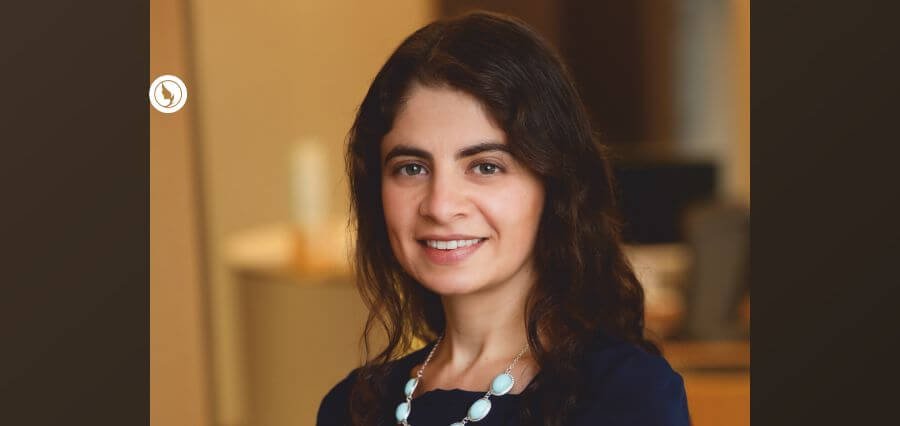
The business school’s auditorium is crowded with students and alumni on a Saturday morning. Marina Severinovsky stands at the front, about to address the group of DBAs about sustainability risks and opportunities. Today is not typical, however. Among the crowd are her two children, ages 10 and 14, who are there to watch their mother present live for the first time.
For the asset management industry, it also a pivotal moment because it now stands at a crossroads between immediate environmental constraints and mounting cynicism, after years of what proved to be unsustainable optimism. Leadership is now more essential than ever. To be effective, it must combine conviction and pragmatism so that strong beliefs pair with credible delivery of results. Further, the recognition of global necessities must be informed by a deep understanding of local context.
Marina Severinovsky fully embraces these shifting realities. As Schroders’ Head of Sustainability for the Americas, she possesses a unique combination of investment acumen and a passion for sustainability. Her own career path was not traditional for a sustainability practitioner. She did not spend the early part of her career attending climate policy academic forums or working at an environmental NGO. Instead, her formative professional years were spent on trading floors and investment desks across multiple asset classes—commodities, emerging market bonds, insurance linked securities and equities. She learned to interpret markets well before she read her first sustainability report.
That training ground fostered a deep recognition that assessing sustainability is not separate and distinct from pursuing investment excellence. In Marina’s view, integrating ESG is not a diversion but instead a critical component of securities analysis. It can create a genuine information advantage because it provides a way to understand companies more deeply and deliver superior outcomes for clients. She applies sustainability considerations exclusively through an investor’s lens, constantly asking how environmental and social factors create risks and opportunities that will directly impact long term returns.
This clarity about the role of sustainability informs Marina’s leadership style. In a field where dogmatism can too often foster division, she knows that results can better be achieved by exercising empathy. She also recognizes that can be done without sacrificing rigorous standards. Marina Severinovsky builds effective partnerships by listening with a genuine intent to understand varied perspectives and needs and by meeting stakeholders where they are.
An Investment-Driven Path
Marina’s journey to sustainability leadership unfolded over nearly 12 years at Schroders, though sustainability wasn’t her originally planned destination. She came to her current firm after gaining experience in investment banking and management consulting. These fields taught her how value gets created in financial markets.
At Schroders, she deliberately pursued a breadth of experience and worked across a diverse range of asset classes. Her time with commodities taught her about resource markets and supply chains. Exposure to emerging market bonds revealed sovereign risk complexities. Time spent with insurance-linked securities demonstrated how financial instruments can address physical risks. Her work in equities on a quantitative team showed her the power of data-driven analysis.
These weren’t accidental moves. Mentors guided her to gain exposure to areas where Schroders’ investment capabilities aligned with clients’ critical objectives. When she transitioned to the sustainability group at the end of 2021, all of her previous experience enabled her to bring an investor’s mindset to her new responsibilities of supporting clients’ sustainability goals.
Human-Centered Focus
While climate and nature dominate sustainability conversations globally, Marina Severinovsky fully understands the broader environmental trends have a direct impact on human lives. Physical climate risk matters because communities need resilience tools like climate insurance to recover from disasters. Rising temperatures matter because workers face dangerous heat stress. Sustainable food and water systems are critical because populations depend on them to thrive.
Understanding the human impact helps abstract concepts quickly translate into concrete investment questions. Marina Severinovsky works to determine which investments will provide solutions and which are likely to face mounting risks. This pragmatic framing connects sustainability to fundamental analysis and helps investment teams identify which companies will thrive as the world changes.
Navigating Turbulence
The past few years have tested sustainable investing profoundly. Marina Severinovsky is candid in her assessment: “The period before 2022 represented an overshoot. ESG fund performance correlated with US large-cap growth stocks, and that attracted ‘tourist capital’ drawn by returns rather than conviction. Marketing-driven commitments grew increasingly ambitious, and sometimes disconnected from reality.”
The inevitable correction left scars. Both investors and asset managers emerged wary. Marina Severinovsky published a white paper, Seeing ESG through a US Lens, before the backlash intensified and she cautioned that the industry needed empathy and a respect for different perspectives.
Her response emphasizes pragmatism and common ground, especially in areas like governance, human capital management and human rights. She highlights opportunities along with risks because active investors want to identify where value gets created. With colleagues and clients, she moves past box-ticking toward investment integrity and meeting specific objectives.
Partnership as Philosophy
Marina’s leadership focuses on creating strong partnerships and serving as a trusted resource. She sits on the same side of the table with stakeholders, demonstrating that her role is to support their success. For London-based colleagues, she serves as their conduit to the Americas. For local teams and clients, she provides comprehensive access to the firm’s capabilities.
When resistance emerges, she leads with respect and empathy, listening to understand pain points before proposing solutions. Her team shares insights generously, partners on research, delivers trainings, and provides access to proprietary tools. The strategy begins with building trust and doesn’t attempt to offer solutions until needs are thoroughly understood.
Marina Severinovsky spends considerable time helping people navigate specific challenges, making introductions that support colleagues’ efforts to expand their networks and recommending solutions for clients facing external pressures. Her team produces research on the links between facets of sustainability and market performance. Rather than simply convey her views, she engages in two-ways conversations that will deliver value, bridge gaps and build common ground.
Inspiring Opportunity
Creating opportunity is an essential focus at Schroders. Many jurisdictions impose compliance requirements, and the firm meets those by maintaining rigorous frameworks. But Marina Severinovsky views these as a baseline from which opportunities can be explored. The genuine solutions can reach far beyond compliance.
Her firm uses in-depth research and engagement with companies to develop a holistic understanding of how they are adjusting to long-term trends such as the energy transition, demographic shifts, and technological disruption. That understanding informs their portfolio construction. As active investors with extended horizons, they think that recognizing how markets are evolving is essential.
The critical question is: which companies will not only survive but also thrive by leading their peers or providing in-demand solutions? Marina Severinovsky helps investments teams see sustainability as central to fundamental analysis. If a business model depends on depleting resources, then sustainability analysis is a critical component of business risk analysis. When engagement with a company reveals they are developing pioneering solutions, that constitutes opportunity identification.
Mentoring Next Generations
Over 15 years at Schroders, Marina Severinovsky has engaged extensively with younger professionals who are passionate about sustainability. She encourages them to listen to their inner voice and consider the personal strengths that will enable them to make important contributions to the field. That is far more important than trying to determine what the latest trends are and what areas might seem to currently offer the most promising career path.
This is because, in the business world, everything goes through cycles, including sustainability. Building lasting careers requires weathering the ups and downs and finding authentic meaning in the work you do. Marina Severinovsky also emphasizes that it is critical to have a thorough grounding in capital markets and investment principles. A deep interest in climate or social issues isn’t sufficient on its own. Asset managers have to view these issues through rigorous investment lenses. Becoming an effective leader in sustainability demands both a commitment to understanding global challenges and sophisticated expertise in how capital markets can function to address them.
A Legacy of Optimism
With her children watching, Marina Severinovsky spoke about looking forward with opportunity and optimism. Even at their young age, her kids are already thinking about professional paths that will enable them to contribute meaningfully and deliver solutions to societal needs. It makes her proud that they see their futures as opportunities to contribute.
For leaders in investment management and sustainability, the ultimate goal is to fund and inspire the human capability and ingenuity that find effective and innovative ways to embrace the opportunities and address the challenges that lie ahead. It’s not about imposing restrictions, and instead entails identifying, funding, and scaling solutions that will ensure capital can both generate returns and deliver impact.
For Marina, having her children watch that Saturday morning crystallized insights about her desired legacy. She’s worked to provide leadership that frames sustainability in ways that foster inclusivity and don’t need lead to exclusion. She wants to make clear that sustainability can encompass pragmatic endeavours that create durability and resilience while meeting fiduciary responsibilities.
This vision—which remains pragmatic yet hopeful, investment-driven yet outcomes-focused—captures Marina’s distinctive approach. In a field marked by polarization, she charts a course that leads to genuine integration and measurable results. Her legacy will be measured in the capital that is moved toward solutions, the innovations that are funded, and the possibilities that are opened for the next generation. In her children’s eyes, that Saturday morning will serve as a model of how professional leadership can serve larger purposes while still maintaining integrity to investment responsibilities. It will serve as a lesson on how doing well and doing good do not have to be in conflict when those two goals are approached with sophistication, integrity, and an unwavering commitment to excellence.