
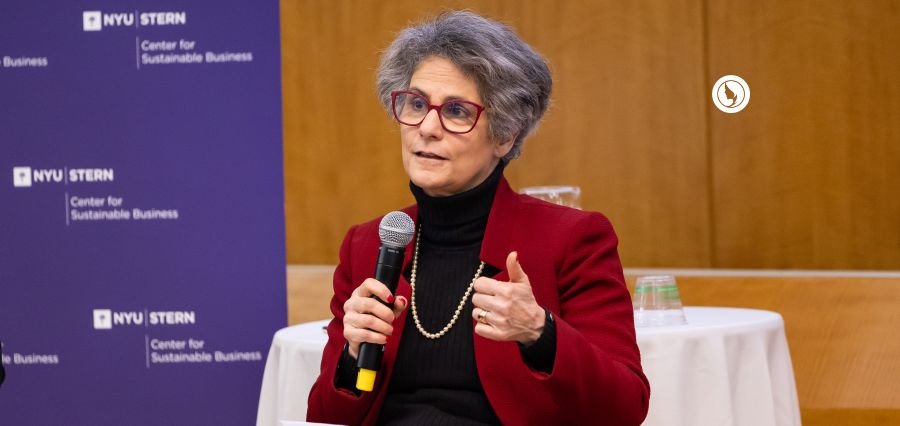
As sustainability took center stage in the business world, Helen Sahi had already seen firsthand the effects of industries on the environment. As an environmental scientist, she started her career learning about soil and water contamination, looking at the long-term implications of past decisions that were made many years before any attempts at clean-up began. With each new project, Helen saw how much deeper the environmental impact went beyond just contamination.
Understanding that there is far more power in prevention than in remediation, Helen knew that it was time to take action and start addressing some of the underlying reasons behind the pollution. Armed with this idea, Helen Sahi left the scientific world behind and entered the business world, where for many years she has advised companies on the issue of sustainability. By taking a proactive approach, she has shown time and again that sustainability does not hinder business success.
Driving Sustainability Through Business Integration
Today, Helen serves as Group Sustainability Officer at BIC, one of the world’s most recognized consumer goods companies. Her role goes far beyond the traditional sustainability function. She works across product design, supply chain operations, brand strategy, and long-term business planning to embed environmental and social responsibility into every aspect of the company’s operations.
Helen Sahi advocates a practical approach to sustainability that moves beyond annual reports and corporate social responsibility initiatives. Instead, she focuses on integrating sustainability into core business processes. Helen Sahi emphasizes that the most successful organizations are those that integrate sustainability into their core business strategy by linking ESG priorities to key drivers such as cost, risk management, growth, and brand value. “Sustainability only succeeds when it delivers ROI,” Helen explains. “It gives us a structured way to quantify risk, reduce exposure, and capture opportunity, turning what was once seen as a cost into a driver of long-term value.”
At BIC, this approach is reflected in tangible actions. Helen Sahi and her team drive material innovation and circular product design while incorporating sustainability considerations into procurement decisions and capital allocation processes with the same rigor applied to financial performance. She also emphasizes the importance of strong governance, believing that sustainability should not be confined to isolated reporting functions. Instead, it must be embedded within performance management systems where accountability is clearly defined and measurable.
The Decade That Changed Everything
When asked about the evolution of sustainability leadership over the past decade, Helen Sahi describes the transformation as significant. Ten years ago, ESG was largely viewed as a corporate responsibility initiative. While it was considered important, it often remained separate from core business strategy. Boards discussed sustainability, and dedicated committees managed it, but business priorities typically centered on fqinancial performance.
Today, that approach has changed dramatically. Increasing regulatory requirements, including mandatory climate disclosures and product-level environmental standards, have made sustainability a business imperative. Organizations are now expected to meet strict deadlines, provide auditable data, and demonstrate measurable progress. Helen notes that evolving regulatory and stakeholder expectations have encouraged organizations to move beyond broad commitments and adopt more rigorous, data-driven sustainability practices.
However, the most important change, in her view, is the shift in mindset. Companies are increasingly adopting a systems-thinking approach. Instead of focusing on isolated initiatives, they are evaluating entire value chains, reconsidering material choices, and incorporating circularity into product design from the beginning. For Helen, a strong advocate of systems thinking, this evolution reflects a more effective and forward-looking way of addressing sustainability challenges.
Building Impact Through Sustainability
Helen Sahi is known for her practical and results-oriented approach to sustainability. Rather than focusing on broad aspirations, she emphasizes initiatives that deliver measurable outcomes. At BIC, every sustainability effort must contribute to clear objectives such as reducing emissions, improving product safety, or increasing the use of recycled materials. She believes that sustainability metrics should be meaningful and closely aligned with business operations rather than serving as simple reporting indicators.
A key element of her leadership philosophy is prioritization. Helen Sahi believes that meaningful impact comes from focusing on initiatives that can be scaled effectively across the organization. She encourages her team to integrate sustainability considerations into product development from the earliest stages. Instead of being treated as a final review step, sustainability becomes a core design principle that influences decisions throughout the development process. This approach helps make sustainability an integral part of how products are created.
Helen Sahi also views sustainability as a driver of innovation and growth. She establishes clear goals related to material selection, emissions reduction, and environmental performance, while empowering teams to identify the best solutions. She believes that the strongest innovations emerge through collaboration among research and development, procurement, and marketing teams. At the same time, she encourages experimentation and continuous learning, recognizing that progress often requires testing new ideas, learning from setbacks, and refining approaches over time.
Leading with Clarity and Resilience
Leading sustainability at a global consumer goods company requires the ability to work effectively across different cultures, business functions, and levels of leadership. Helen believes that successful sustainability leaders must demonstrate three key qualities: clarity, resilience, and empathy.
According to Helen, clarity is essential in a field often characterized by complexity. Sustainability involves large amounts of data, evolving standards, and multiple priorities. Leaders who can translate these complexities into clear objectives and practical actions are more likely to drive meaningful progress. People need to understand both what is expected of them and how their efforts contribute to business success.
Resilience is equally important. Driving transformation takes time and often involves overcoming challenges such as budget constraints, shifting priorities, and resistance to change. Helen Sahi remains focused on long-term goals while delivering measurable short-term results. She believes that consistent progress builds credibility, and credibility creates opportunities for larger and more impactful changes.
Empathy and collaboration complete her leadership approach. Sustainability affects every part of the organization, from finance and research and development to marketing and operations. Helen Sahi works closely with each function, recognizing their unique perspectives and priorities. Rather than seeking compliance, she focuses on building alignment and shared commitment. Helen emphasizes that successful sustainability leadership requires understanding diverse perspectives, fostering alignment across teams and cultures, and influencing stakeholders toward shared goals.
Influence Through Authenticity
Helen Sahi approaches leadership with realism and determination. Like many women who have built successful careers in technical and corporate environments, she has often found herself in situations where she needed to establish credibility and demonstrate expertise. These experiences have shaped her leadership philosophy and strengthened her commitment to creating opportunities for others.
Her approach is built on four key principles: preparation, presence, confidence, and advocacy. She believes in being well-informed, communicating with clarity, and maintaining confidence without the need to overstate her position. Equally important is using leadership opportunities to support and empower others within the organization.
Helen Sahi also believes that authenticity is a critical leadership quality. Guided by her belief that authenticity, commercial rigor, and strong values can coexist, Helen is committed to fostering inclusive workplace cultures where diverse perspectives are respected, encouraged, and valued as drivers of better decision-making and innovation.
Through her experience, Helen Sahi has seen that diverse teams consistently make better decisions and drive stronger innovation. As a result, she remains committed to fostering environments where every voice has the opportunity to contribute meaningfully and influence outcomes.
What the Future Demands
Helen Sahi believes the future of sustainability will be shaped by four key trends. First, increasing regulation and standardization will require companies to move beyond voluntary commitments and demonstrate measurable, verifiable performance. Second, product-level sustainability will become even more important as consumers, regulators, and investors place greater focus on how products are designed, used, and managed throughout their lifecycle.
She also expects circular economy principles to play a larger role in business strategy. Organizations will increasingly shift away from traditional linear models and adopt approaches that emphasize resource efficiency, reuse, and closed-loop systems. At the same time, sustainability will become further integrated into core business operations and leadership responsibilities, evolving from a specialized function into a fundamental business expectation.
For professionals entering the field, Helen Sahi emphasizes the importance of developing both technical expertise and business acumen. She believes the most successful sustainability leaders are those who can connect environmental and social priorities with business objectives and communicate effectively with senior decision-makers.
Helen Sahi also highlights the value of resilience. Meaningful progress in sustainability often takes time, and transformational change rarely follows the pace of short-term business cycles. Maintaining focus and commitment during periods of gradual progress requires a strong sense of purpose and a long-term perspective. In her view, these qualities are essential for creating lasting impact in the sustainability field.
Building a Lasting Legacy
When discussing her legacy, Helen Sahi focuses not on recognition or milestones but on integration. Her vision is a future where sustainability is fully embedded into everyday business decisions, becoming a natural and expected part of how organizations operate rather than a separate consideration.
Helen Sahi believes that demonstrating the value of sustainable practices for businesses, consumers, and the environment is essential to driving meaningful and long-term systemic change. This perspective reflects a balanced approach that combines ambition with practicality and long-term thinking with measurable action.
Throughout her career, Helen Sahi has remained committed to understanding the broader impact of business decisions. Her career demonstrates the importance of looking beyond immediate outcomes to understand how decisions made today shape future results. For many emerging sustainability professionals, this commitment to systems thinking, business integration, and long-term value creation may become one of her most significant and enduring contributions.